Select Your Favourite
Category And Start Learning.

Premium Program

Full-Stack
Artificial Intelligence Engineer Program

India’s First Premium Program

Full-Stack Artificial Intelligence Engineer Program – Premium Batch will empower the students with expert level training from Top Managers from Companies like TCS, IBM and Value Labs.

This is India’s First Premium Program which is expected to give your High Salary Job Opportunities.

India's 1st Premium Batch!

Only one batch per year !

Duration: 8 to 10 Months

Mode: Live Online Training

Mon, Wed & Fri : 7 PM to 9 PM

Program Fee: 2,00,000 INR

Course Overview

A Full-stack AI Engineer is a professional with expertise across the entire stack of artificial intelligence (AI) and machine learning (ML) development. A Full-stack AI Engineer plays a critical role in the end-to-end development and deployment of AI systems, bridging the gap between data science and software engineering.


Job Opportunites

Students can expect positions as Date Scientists, AI Scientists, Prompt Engineers, Machine Learning Engineer, Business Analysts and Statistical Programmers. 

Why is it Important to Join the Program?

Training is provided by Managers from Top companies like TCS, IBM and Value Labs. This program will make students eligible for many positions in top companies.

Full Syllabus

  • What is IT?
  • Hardware vs. Software
  • Operating Systems (Windows, macOS, Linux)
  • Understanding the Internet and How It Works
  • IP Addressing
  • DNS
  • HTTP/HTTPS
  • Introduction to HTML
  • Basic Tags and Elements
  • html forms
  • Creating Simple Web Pages
  • Introduction to CSS
  • Basic Styling
  • Layouts and Positioning
  • Overview of Software Development Lifecycle
  • Different Models: Waterfall, Agile, Scrum
  • What is a Database?
  • Types of Databases (Relational vs. Non-relational)
  • Overview of SQL (Structured Query Language)
  • Introduction to SQL Syntax
  • Using a SQL Interface (e.g., SQL Workbench, pgAdmin, MySQL Workbench)
  • SELECT Statement
  • SELECT DISTINCT
  • WHERE Clause
  • Logical Operators (AND, OR, NOT)
  • INSERT INTO
  • UPDATE
  • DELETE
  • Basic SQL Functions (COUNT, SUM, AVG, MIN, MAX)
  • Using Aliases
    Concatenation and Arithmetic Operations
  • ORDER BY
  • LIMIT (or TOP in some databases)
  • Filtering with LIKE
  • Introduction to Joins
    INNER JOIN
    LEFT JOIN
    RIGHT JOIN
    FULL OUTER JOIN
  • GROUP BY
  • HAVING Clause
  • Aggregate Functions with GROUP BY
  • Introduction to Subqueries
    Subqueries in SELECT
  • Subqueries in WHERE
  • COALESCE and NULLIF
  • Self Joins
  • Cross Joins
  • Natural Joins
  • Creating and Using Views
  • Correlated Subqueries
  • EXISTS and NOT EXISTS
  • INSERT INTO SELECT
  • Window Functions (OVER, PARTITION BY)
  • Rank-related Functions (RANK, DENSE_RANK, ROW_NUMBER)
  • String Functions (SUBSTRING, LENGTH, REPLACE, etc.)
  • Date and Time Functions (NOW, DATEADD, DATEDIFF, etc.)
  • Normalization (1NF, 2NF, 3NF, BCNF)
  • Primary and Foreign Keys
  • Introduction to Transactions
  • COMMIT and ROLLBACK
  • Creating and Using Views
  • What is programming?
  • Why python?
  • Installation windows
  • Variables
  • Naming convention
  • Operators
  • Condition operator
  • Relational Operator
  • Data types
  • Loops
  • Functions
  • Introduction to OOP
  • Classes & Objects
  • Attributes and methods
  • init method
  • Encapsulation
  • Inheritance (SIngle multiple & multilevel)
  • Polymorphism
  • Abstraction
  • Special Methods (Magic/Dunder Methods)
  • Class Methods and Static Methods
  • Operator Overloading
  • Creating and Importing Modules
  • Python Standard Library
  • Lambda Functions and Functional Programming
  • Error and Exception Handling
  • File Handling
  • Collections Module: namedtuple, deque, Counter, etc.
  • Iterators and Iterables
  • Generators and yield
  • Context Managers and the with Statement
  • Decorators
  • Property Decorators: @property
  • Coroutines and asyncio
  • Multithreading programming
  • The concurrent.futures Module
  • Nosql database : mongoDB atlas
  • CRUD operations using python
  • Introduction to API
  • Overview of FastAPI
  • Setting up a FastAPI Project
  • Basic Routing
  • Path Parameters
  • Query Parameters
  • Request Bodies
  • Form Data
  • File Uploads
  • JSON Responses
  • HTML Responses
  • Response Models
  • Handling Authentication and Authorization
  • OAuth2 with Password (and hashing)
  • Connecting to Databases (e.g., SQLAlchemy, Tortoise-ORM)
  • Creating Database Models
  • CRUD Operations
  • What is Version Control?
  • Initializing a Repository
  • Committing Changes
  • Git branch
  • Git merge
  • Pull request
  • Git ignore
  • README file
  • Ordinal data type
  • Nominal Data type
  • Mean, Median, Mode Intituion
  • Practical using Datatset
  • Range
  • Interquartile Range
  • Standard Deviation
  • Variance
  • Practical using Datatset
  • Importance of data distribution
  • Scatter plot
  • Histogram
  • boxplot
  • Line chart
  • Pie chart
  • Data Distribution
  • Basic Probability
  • Conditional probability
  • Binomial Distribution
  • Bayes rule
  • What is normal distribution
  • Descriptive statistics
  • Inferential Statistics
  • What do you mean by popluation, parameter, sample, statistic
  • Law of large numbers
  • Central limit theorem
  • What is A/B testing?
  • A/B Testing using python
  • Hypothesis Testing
  • Alternative & Null hypothesis
  • What is P-value?
  • What is data Analytics
  • Process involves in data analysis
  • Numpy
  • Pandas
  • Matplotlib
  • Reading data
  • Understanding data with basic statistics
  • What is data wrangling
  • What is EDA
  • Data manipulation using numpy and pandas
  • Drawing conclusion for the data using statistics
    Showing results using visualization
  • Data gathering
  • Data Access
  • Data Cleaning
  • Bivariate Exploration of data
  • Univariate Exploration of data
  • Multivariate Exploration of data
  • Project : Data Analysis
  • Introduction
  • Types of machine learning
  • Linear Regression overview
  • Linear Regression In-Depth
  • Loss Function basics
  • Evaluation metrics
  • Optimization Function Basics
  • Dataset splitting
  • Overfitting
  • Underfitting
  • Logistic Regression overview
  • Logistic Regression In-Depth
  • Loss Function basics
  • Evaluation metrics
  • Optimization
  • Function Basics
  • Decision Tree Classification
  • Decision Tree Regressor
  • Cross Validation
  • Ensemble Technique
  • Bagging
  • Boosting
  • Random Forest
  • Hyperparamater Tuning
  • Bias vs Variance
  • Xgboost basics
  • Xgboost Advance
  • KNN
  • Kmeans Clustering
  • Dimensionality
  • Reduction
  • Naive Bayes
  • Support vector machine
  • Spam email classification using Naive Bayes
  • Neural Network Basics
  • Neural Network Practicals
  • Project : Image classification using Neural Network
  • What is Natural Language Processing?
  • Applications of NLP
  • Basic Terminology in NLP
  • Introduction to NLP Libraries – NLTK
  • Introduction to NLP Libraries – SpaCy
  • Introduction to NLP Libraries – Hugging Face Transformers
  • Basic Text Processing:
    Tokenization
    Removing Stop Words
    Stemming and Lemmatization
  • Advanced Text Processing:
    Handling Punctuation and Special Characters
    Normalization (Lowercasing, Expanding Contractions)
    Handling Misspellings and Typos
  • Feature Extraction
    Bag of Words (BoW)
    Term Frequency-Inverse Document Frequency (TF-IDF)
    Introduction to Word2Vec
    GloVe (Global Vectors for Word Representation)
    Universal Sentence Encoder
    Sentence-BERT
  • Task – Text Classification
    Sentiment Analysis
    Spam Detection
  • Sequence Labeling
    Named Entity Recognition (NER)
    Part-of-Speech Tagging (POS)
  • Text Generation and Summarization
    Extractive Summarization
    Abstractive Summarization
    Markov Chains
  • Deep Learning for NLP
    Recurrent Neural Networks (RNNs)
    Long Short-Term Memory (LSTM)
    Introduction to Attention
    Self-Attention and Transformers
    Variational Autoencoders (VAE)
    Generative Adversarial Networks (GANs) for Text
  • Introduction to LLMs
    What are Large Language Models?
    Overview of Popular LLMs (GPT, BERT, T5, etc.)
    Introduction to Hugging Face Transformers
  • Pre-trained LLMs
    Introduction to Hugging Face Transformers
    Loading and Using Pre-trained Models
    BERT for Text Classification
    GPT for Text Generation
  • Prompt Engineering
  • Introduction to Langchain
    What is LangChain?
    Key Features and Capabilities
    Understanding Chains in LangChain
    Creating Simple Chains
    Linking Multiple Chains
    Introduction to Agents in LangChain
    Building Basic Agents
    Using Agents for Task Automation
    Storing and Retrieving Data with VectorDatabase

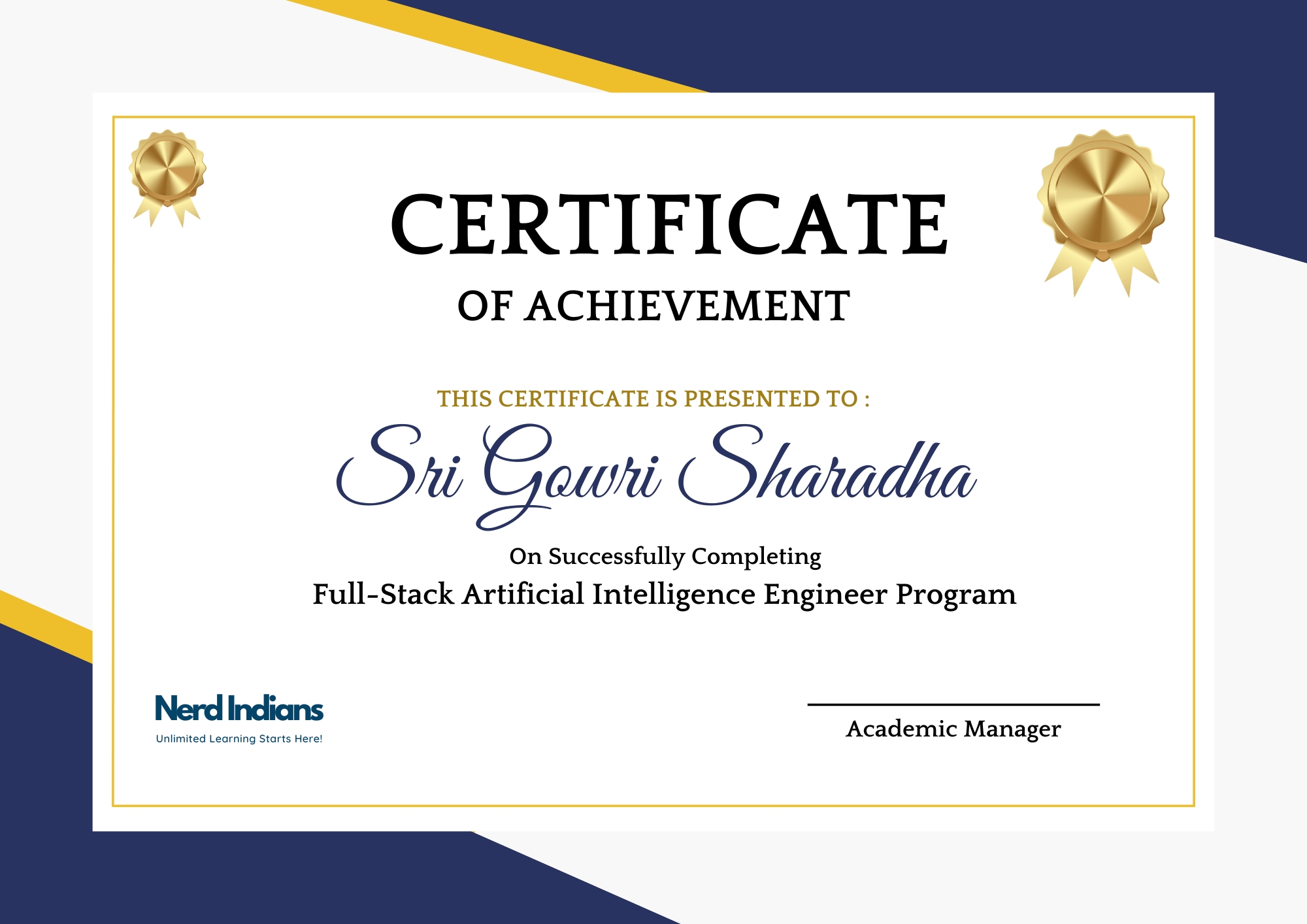
Sample Certificate

How does it work?

1

Register

The students can register by paying 2,00,000 INR.

2

12 Months Access to Continous Learning

Students will get access to recorded sessions access after the Live Online Training for revision and job interview preparation. Students will have access to Continuous Learning Access to Business Analytics, SAS Programming and Statistical Programming.

3

Certifications & Placements

Get Certification and we will also help you by providing job assistance.

4

Early Bird Scholarships

First 10 Students will get access to 20,000 INR Early Bird Scholarship.

Premium Batch

Full-Stack Artificial Intelligence Engineer Program

Get Trained by Top Industry Experts online and also get Certification and Job Assistance.

Frequently Asked Questions

Only Btech, BCA and computer science Final Year Students, Interns, Graduates and Professionals are eligible.

The training is provided live online and supported with the recorded sessions through our Learning Management System (LMS). Few Courses are supported by only temporary recordings.

The training duration is 6 to 8 Months and Project duration may take 2 Months. Access to continuous learning programs is for full 12 months.

After the entire program, student has to complete project to receive their certificate.

Yes, we provide Zero interest student loan through Bajaj Finance and Eduvanz.

You will get 12 months student loan to pay your fee of 2,00,000 INR

As there is a huge availability of online learning content but not real corporate level training there is huge number of students stating their skills on their CV but without real hands-on knowledge.  There is a huge requirement of analytics professionals but scarcity of Trained Professionals.  We wish to create 100 Professionals every year and help them find a great career.Â